Every estate planning attorney knows the statistic, because every estate planning attorney has lived it: the most elegantly drafted revocable trust in the world protects nothing if the client’s real property never makes it into the trust. The unfunded trust is the quiet failure of our profession — the plan that was signed, celebrated, billed, and then undone by a deed that was never prepared, never executed properly, or never recorded.
Drafting platforms like InterActive Legal have solved the first half of the problem brilliantly. A well-supported attorney can now produce a sophisticated, state-specific trust instrument in a fraction of the time it once took. But the deed — the instrument that actually moves the client’s largest asset into the plan — still lives in a different world. A slower, stranger, county-by-county world.
One Country, 3,000+ Sets of Rules
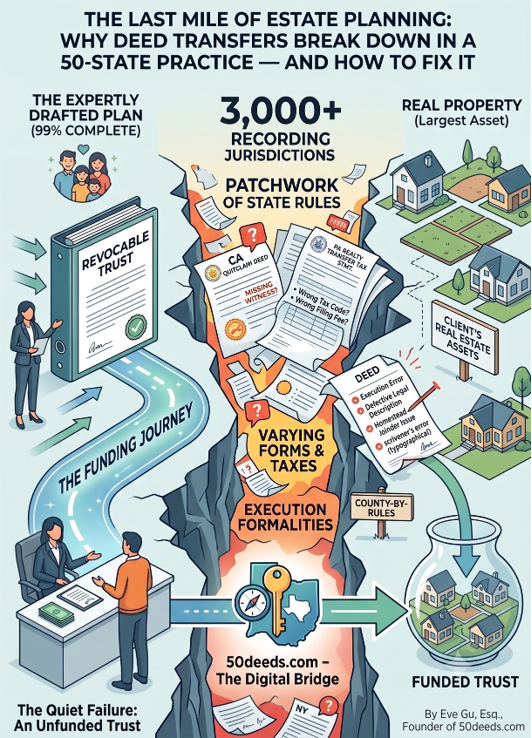
Here is the uncomfortable truth about real property transfers in the United States: there is no such thing as “a deed.” There are more than 3,000 recording jurisdictions, and nearly every one of them has its own preferences, formatting requirements, transfer tax forms, and rejection triggers.
Consider just a few of the traps waiting for an attorney who drafts a trust in one state for a client who owns property in another:
Execution formalities vary in ways that are easy to miss. Some states require two witnesses in addition to notarization. Some require none. A deed executed with the formalities of the attorney’s home state may be flatly unrecordable — or worse, recordable but voidable — in the state where the property sits.
Transfer tax and exemption regimes are a patchwork. A transfer into a revocable trust is exempt from transfer tax in most jurisdictions — but the exemption is almost never automatic. It must be claimed, on the right form, citing the correct statutory subsection, with vesting language that satisfies the statute’s conditions. Pennsylvania’s realty transfer tax statement, New York’s TP-584, California’s preliminary change of ownership report, and dozens of state-specific affidavits each have their own logic.
Some states have quirks that surprise even experienced practitioners. New York City’s ACRIS system is effectively its own regulatory universe. A handful of states still give legal effect to archaic doctrines — dower and curtesy waivers, homestead joinder requirements that apply even when only one spouse holds title — that can invalidate a transfer signed by the “wrong” combination of people. Community property states treat trust funding differently than common law states. And roughly half the states have enacted transfer-on-death deed statutes, while the rest have not, which changes the planning conversation entirely depending on where the property sits.
Post-death transfers add another layer entirely. When the plan is administered rather than funded, the deed work gets harder, not easier. Clearing a deceased owner from title might require an affidavit of heirship in one state, a certified death certificate recording in another, an executor’s deed with letters testamentary attached in a third, and an ancillary probate proceeding in a fourth. Getting the sequence wrong doesn’t just delay a sale — it can push the family into exactly the court process the decedent paid to avoid.
Legal descriptions are unforgiving. Pulling the description from an old deed sounds simple until the prior deed contains a scrivener’s error, a partial release, or references a plat that has since been re-recorded. A deed with a defective legal description may record without objection — and cloud title for a decade before anyone notices.
For an attorney whose practice is concentrated in one state, these are manageable. But estate planning clients are not concentrated in one state. They own the vacation condo in Florida, the inherited farmland in Iowa, the rental duplex in Texas, the co-op in Manhattan. The moment a client’s asset schedule crosses a state line, the attorney faces an unattractive menu of options.
Why the Traditional Options Fall Short
Option one: learn the jurisdiction yourself. For a single deed, this means hours of unbillable research into another state’s execution formalities, transfer tax forms, and county recording standards — research that goes stale before you need it again, because the next client’s out-of-state property will be somewhere else. And research alone doesn’t surface the unwritten preferences of a particular recorder’s office, which is where most rejections actually originate.
Option two: engage local counsel. This is the traditionally “safe” answer, and for genuinely contested or complex title matters it remains the right one. But for a routine trust-funding deed, it is wildly inefficient. You spend time finding a firm willing to take a $500 matter, wait days or weeks for a response, pay hourly rates that dwarf the value of the task, and manage a referral relationship for what should be a two-day turnaround. Many attorneys quietly absorb the cost rather than pass it to the client, turning the deed into a loss leader with liability attached.
Option three: hand the client a deed and instructions. This is the option nobody admits to, and it fails most often. Clients sign in the wrong place, use a notary who omits required language, mail the package to the wrong office, or simply put the envelope in a drawer. The attorney’s file shows the deed was “delivered to client for recording” — which is cold comfort when the property surfaces in probate five years later.
None of these options exists because it works well. They exist because, until recently, there was no purpose-built alternative.
The Malpractice Math Doesn’t Favor Doing It Yourself
The economics here deserve honest attention. A deed transfer is typically a low-fee line item in an estate planning engagement. But the liability it carries is not proportional to the fee. An unrecorded or defective deed can mean a probate proceeding the plan was designed to avoid, an unintended transfer tax assessment, or a title claim years later. The exposure is measured against the value of the property, not the value of the deed prep fee.
That asymmetry — small fee, large tail risk, high jurisdictional variance — is precisely the profile of work that benefits from specialization. It is the same logic that led our profession to embrace dedicated 1031 intermediaries, corporate registered agent services, and, yes, document drafting platforms. Nobody thinks less of an estate planner for not maintaining their own HotDocs codebase. The question is why so many of us still treat out-of-state deed preparation and recording as something to improvise.
Alternative Approach: Standardizing Deed Preparation and Recording Nationwide
One of the more persistent operational challenges in estate planning is the variability of deed preparation and recording requirements across jurisdictions. Differences in execution standards, transfer tax rules, formatting, and county-level procedures can introduce delays and increase the risk of errors—particularly for firms working across multiple states.
To address this, a centralized approach to deed preparation and recording has gained traction. In this model, attorneys or their staff provide core inputs—property details, current vesting, and the intended planning objective, such as funding a revocable trust, transferring ownership to an entity, modifying title, or correcting ownership after death. The deed process is then managed from preparation through recording, regardless of location.
A key feature of this approach is the use of attorney oversight combined with jurisdiction-specific rule frameworks. Rather than relying solely on static templates, deed preparation is informed by current state and county requirements, including execution formalities, witnessing standards, formatting conventions, and transfer tax considerations. This structure is designed to reduce rejection rates and improve consistency across filings.
Flat-fee pricing is another common component, allowing firms to set clear expectations with clients at the outset of an engagement. This can simplify scoping and reduce administrative friction, particularly in practices where property transfers are a routine part of trust planning.
Turnaround time is also a meaningful factor. When deed preparation is aligned with the broader estate planning timeline, firms are better positioned to complete trust funding concurrently with document execution, rather than treating it as a separate, follow-on task. This helps reduce the likelihood of partially implemented plans.
Equally important is the recording process itself. County-level fragmentation—ranging from fully electronic systems to manual submission requirements—can create inconsistent outcomes if not actively managed. A centralized workflow typically includes submission through the appropriate channel, along with tracking through confirmation, to ensure the recorded instrument is returned and incorporated into the client’s final documentation.
From a process standpoint, the workflow is relatively straightforward: submission of property and planning details, retrieval and review of the most recent recorded deed, verification of the legal description, preparation of the appropriate instrument and supporting documentation, execution with jurisdiction-specific instructions, and final submission for recording.
For firms operating in multiple jurisdictions or adopting technology platforms designed for multi-state estate planning, this type of model offers a way to standardize a traditionally fragmented process. More importantly, it supports a more consistent outcome: completed and properly recorded deeds that align with the client’s overall estate plan.
50Deeds.com was founded on these principles.
Visit our website to learn how 50Deeds.com might be a better fit for your firm.
Meet the Author:

Eve Gu, Esq., is the founder of 50Deeds.com, a nationwide flat-fee deed preparation and recording service for estate planning and elder law attorneys. She has practiced as a senior real estate attorney in Georgia since 2007, beginning her eight-year tenure with McKenna Long & Aldridge (now Dentons). Before founding 50deeds, Eve served as Chief Operating Officer of a Singapore-based real estate investment company. Earlier in her career, she held positions in Investment Banking at J.P. Morgan in New York and at KPMG in Atlanta. She brings more than a decade of experience spanning commercial real estate acquisition and development, asset and property management, real estate law, and corporate law. To learn more about adding nationwide deed preparation and recording services to your practice, visit 50Deeds.com.